
Multi-actor workflows
Give owners and attackers isolated headers, cookies, and HTTP sessions.
Free · local-first · Apache-2.0
ExploitSpec turns a proven HTTP exploit into a small, reviewable regression test—so CI can catch the behavior if it returns.
Listed as an API testing tool in the OWASP® Community API Security Tools list. OWASP® is a registered service mark of the OWASP Foundation, Inc. Inclusion does not imply endorsement, certification, or OWASP project status.
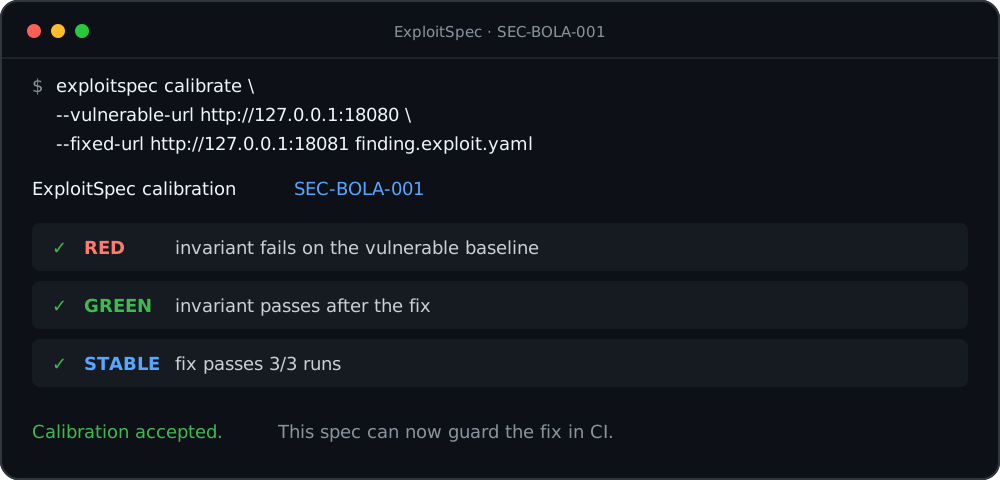
$ exploitspec calibrate finding.yaml
Calibration accepted. Ready for CI.
Evidence in. Signal out.
Keep the exploit's security invariant beside the application code, where engineers can rerun it locally and in CI.
Take a vulnerability already confirmed by a human—such as a BOLA/IDOR finding.
Describe actors, requests, dynamic values, and the boundary the fix must preserve.
Prove RED, GREEN, and STABLE—then fail the build if the vulnerability returns.
Designed for security boundaries
ExploitSpec stays deliberately narrow: it replays invariants that a human has already decided are meaningful. It is not a vulnerability scanner.
Give owners and attackers isolated headers, cookies, and HTTP sessions.
Capture an ID, header, or regex match and reuse it in later requests.
Emit readable text, machine-readable JSON, or JUnit for ordinary pipelines.
Require explicit remote-host authorization, bound responses, and block metadata IPs.
Turn selected cURL or HAR requests into conservatively redacted starter specs.
One Apache-2.0 edition. No hosted service, analytics, or feature gates.
Start in one command
Use the verified Homebrew tap on macOS or Linux, or install the latest tagged release with Go. Prebuilt archives are available for macOS, Linux, and Windows.
Homebrew
brew install pazent/exploitspec/exploitspecGo
go install github.com/pazent/exploitspec/cmd/exploitspec@latestThe bug was fixed.
Run the local BOLA/IDOR demo, inspect the YAML, and decide whether ExploitSpec belongs in your CI.